

15 Indoor Activities That Encourage Creative Thinking in Kids
Is there a more common parental challenge than the cry of, I am bored, echoing through the house on a rainy afternoon? While it is tempting to hand over a tablet to secure an hour of peace, the digital world often leaves a child’s natural curiosity untapped. Finding meaningful ways to keep your little ones engaged indoors is not just about filling time; it is about cultivating their potential.
Creative thinking is the foundation of innovation and emotional intelligence. In the context of child development, it is not merely about painting pretty pictures. Instead, it is the ability to connect disparate ideas, approach problems from new angles, and remain resilient when faced with a challenge. By incorporating intentional, open-ended play, you can transform your living room into a vibrant hub of imagination.
Why Creative Play Matters for Brain Development
At the heart of creative thinking is divergent thinking—the ability to generate multiple solutions to a single problem. When a child engages in open-ended play, they are essentially practicing the neural pathways necessary for high-level cognitive growth. Unlike goal-oriented games with rigid rules, open-ended play forces a child to define their own parameters. You can explore more about why imagination matters in our complete guide to pretend play for child development.
Interestingly, boredom is often the catalyst for this growth. When the constant stream of external entertainment stops, the brain begins to search for its own stimulation. This is when the true magic happens. By providing the tools for creative expression rather than the answers, we empower our children to become active learners rather than passive consumers.
1. Artistic Exploration (Beyond Coloring)
Artistic endeavors are the most accessible way to encourage creative thinking in kids. Move beyond standard coloring books and invite your child to explore new mediums.
Mixed-Media Collage
Gather recyclables like cereal boxes, fabric scraps, and items from nature such as leaves or twigs. Challenge your child to create a 3D scene using only these materials.
Draw-a-Story Challenge
Start a story with one sentence and ask your child to draw the next scene. Alternate between words and pictures to build a complex narrative that evolves visually.
Process Art
Focus on the act of creating rather than the final product. Set out diverse materials—like oil pastels, watercolors, and textured sponges—and encourage your child to explore how the materials interact without a specific goal in mind. Find more inspiration in these creative finger painting and coloring activities for toddlers.
2. Construction and Engineering Challenges
Young engineers learn best through trial and error. These activities turn structural planning into a game of creative strategy.
The Box Castle Project
Save your delivery boxes and provide tape and scissors. Ask your child to plan and build a structure that fits a specific toy inhabitant.
Kitchen Physics
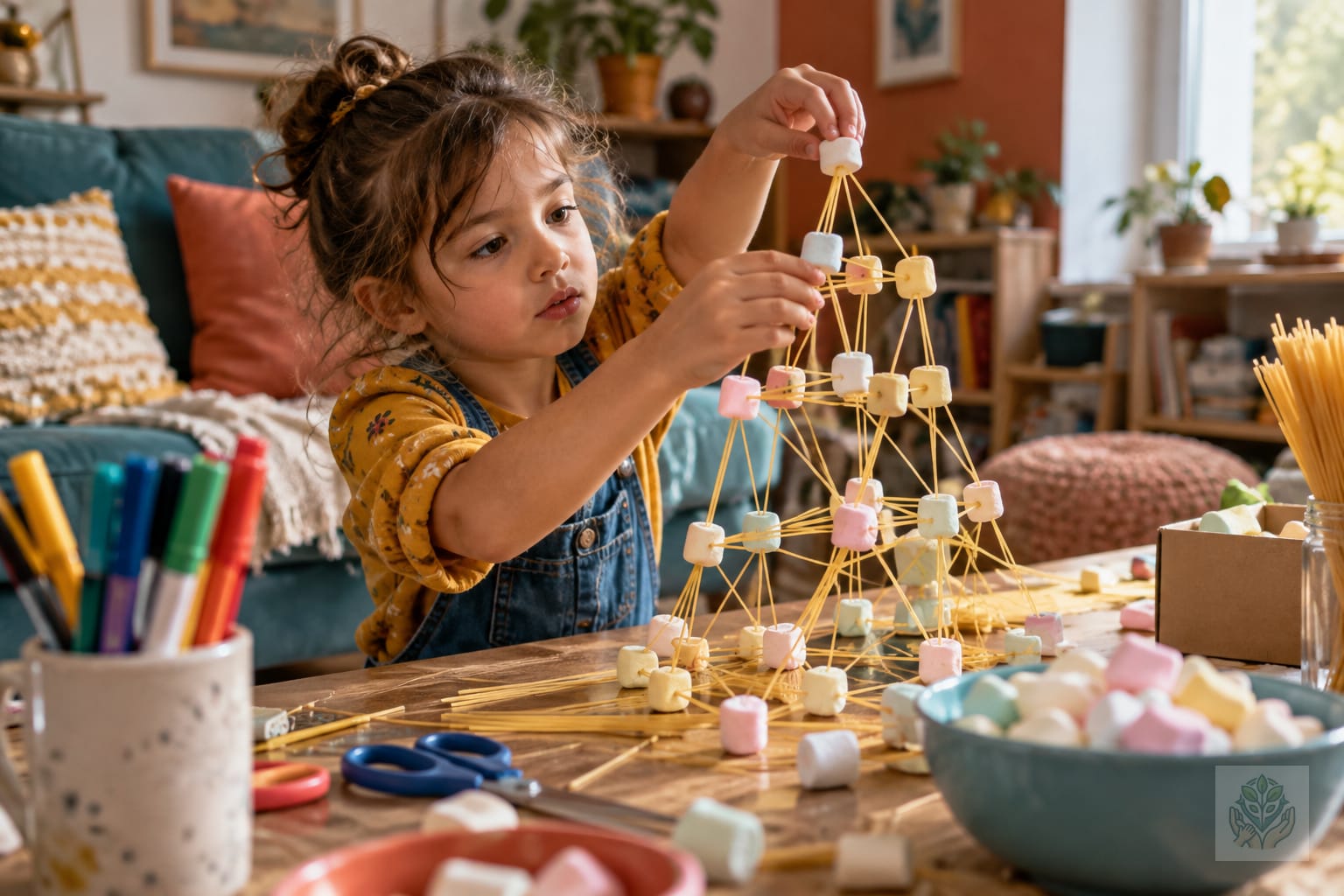
Using dry spaghetti and marshmallows or gumdrops, challenge your child to build the tallest tower that can hold the weight of a small figurine.
Living Room Obstacle Courses
Use pillows, chairs, and blankets to design a course. Encourage your child to solve spatial puzzles by determining the most efficient way to navigate from one end of the room to the other. You can incorporate ideas from these indoor activities that build gross motor skills to make it even more active.
3. Imaginative Role-Play and Storytelling
Role-play is the ultimate training ground for empathy and social problem-solving. By stepping into another persona, children explore different perspectives.
Living Room Theater
Raid your closets for old clothes and linens to create costumes. Let your child write and direct a short play that requires solving a specific conflict within the story.
Collaborative Storytelling
Play the What Happens Next? game. Start a bizarre scenario, such as a giraffe finding a pair of shoes, and have your child invent the next turn of events.
Mock Business
Set up a pretend restaurant or post office. This involves logic-based tasks like designing a menu, setting prices, and managing transactions, which reinforces creative thinking alongside early math skills. For more play sets, check out our guide on the best kitchen pretend play sets every child will love.
4. Cognitive and Logic-Based Creativity
Logic and creativity are not mutually exclusive; they are partners in the investigative mind.
The Reverse Engineer Game
Take an old, non-functional gadget apart with your child. Ask them to hypothesize what each piece does and why it was built that way.
Riddle Scavenger Hunts
Instead of writing down items to find, write clever riddles that describe the location of the next clue. This forces children to analyze language and spatial relationships.
Sensory Science
Create custom potions using safe household items like water, food coloring, and baking soda. Encourage your child to experiment with ratios and observe how the mixtures react. You can also try adding some of these fun sensory bin fillers for toddlers to your playtime routine.
Tips for Parents: Creating an Environment for Creativity
To truly foster innovation, you must curate an environment that supports it. Start by dedicating a small Maker Space or Creativity Corner in your home where your child has access to basic supplies like paper, tape, and markers.
Rotating toys is another powerful strategy. By hiding away half of their toy collection and swapping them every few weeks, you maintain a sense of novelty and interest in the items they already own. Remember, your role is that of a facilitator, not a director. Offer prompts instead of instructions, and celebrate the process rather than the result. To select the best options, consult our age-wise toy buying checklist for parents.
Finally, address the mess factor. Setting healthy boundaries, such as keeping art supplies on a vinyl tablecloth or limiting construction to a specific rug, allows you to relax and enjoy the creative chaos without the stress of constant cleanup.
Conclusion
Creativity is a muscle that needs regular exercise to grow. By providing your children with these 15 indoor activities that encourage creative thinking, you are helping them build the confidence to solve problems, think critically, and find joy in the process of discovery. Start small this weekend with one activity and watch as their imagination takes flight. We would love to hear how it goes; share your child’s most creative indoor project in the comments below!
Frequently Asked Questions
What is divergent thinking in child development?
Divergent thinking is the ability to generate multiple solutions to a single problem, forming the foundation of high-level cognitive growth and creativity.
Why is boredom good for kids?
Boredom acts as a catalyst for growth by stopping external entertainment, forcing the brain to search for its own stimulation and spark imagination.
What is process art?
Process art focuses on the act of creating rather than the final product, allowing children to explore how materials interact without strict rules.
How do construction challenges help kids?
Construction challenges help young engineers learn through trial and error, turning structural planning into a fun game of creative strategy.
How can parents create an environment for creativity?
Parents can curate an environment by setting up a dedicated maker space, rotating toys to maintain novelty, and offering open-ended prompts.
Are logic and creativity related?
Yes, logic and creativity are close partners in the investigative mind, working together to solve problems and analyze spatial relationships.


