

10 Best STEM Toys That Improve Logical Reasoning Skills in Children
In today’s rapidly evolving world, parents are increasingly looking for ways to give their children a cognitive edge. While academic performance is important, the foundation of future success lies in the ability to think critically and solve problems effectively. This is where the best STEM toys that improve logical reasoning skills come into play. By integrating Science, Technology, Engineering, and Math into daily recreation, you provide your child with the tools to navigate complex challenges with confidence. To ensure your home is fully equipped for this type of growth, consider building a simple preschool learning corner.
Logical reasoning is the backbone of cognitive growth. It involves the ability to analyze information, identify patterns, and draw conclusions based on evidence. When children engage with toys that require them to think through a process rather than just following passive instructions, they are actively building neural pathways that support executive function. Intentional play acts as a workout for the brain, turning abstract concepts into tangible experiences.
Why STEM Toys Are Essential for Logic Development
Many parents wonder if play-based learning truly translates to real-world problem solving. The answer is a resounding yes. STEM toys are specifically engineered to encourage children to experiment, fail, iterate, and succeed. This cycle of trial and error is the very definition of scientific inquiry. When a child learns to adjust a building block tower to prevent it from tipping, they are practicing physics and engineering principles without even realizing it. You can explore more on this topic in our complete guide to the educational benefits of STEM toys.
The link between spatial awareness, sequencing, and logic is profound. Sequencing—or the ability to put steps in the correct order—is a fundamental component of mathematical logic. Similarly, spatial awareness helps children visualize how parts of an object relate to the whole. By playing with these toys, children move from concrete thinking to more abstract reasoning, preparing them for the complex subjects they will encounter in school.
Key Features to Look for in Logic-Building Toys
Not all educational toys are created equal. When searching for the best tools to foster your child’s development, look for items that offer open-ended possibilities. While goal-oriented toys are excellent for teaching specific skills, open-ended kits allow children to invent their own solutions, which is a powerful way to foster creativity alongside logic. For general advice on choosing the right playthings, check out our ultimate beginner’s guide to buying age-appropriate toys.
Durability and age-appropriateness are also paramount. A toy that is too complex can cause frustration, while one that is too simple will fail to challenge the brain. Seek out toys that can grow with your child, such as building sets that start as basic structures and evolve into complex machines. Ideally, the best STEM toys should balance Science, Technology, Engineering, and Math in a way that feels like pure, unadulterated fun.
Top Recommended STEM Toys for Logical Reasoning
To help you navigate the crowded toy market, we have curated a list of categories that provide the highest cognitive return on investment.
- Coding Robots: These tools are perfect for teaching sequencing skills. By planning a path for a robot, children learn how to break large problems into smaller, manageable tasks.
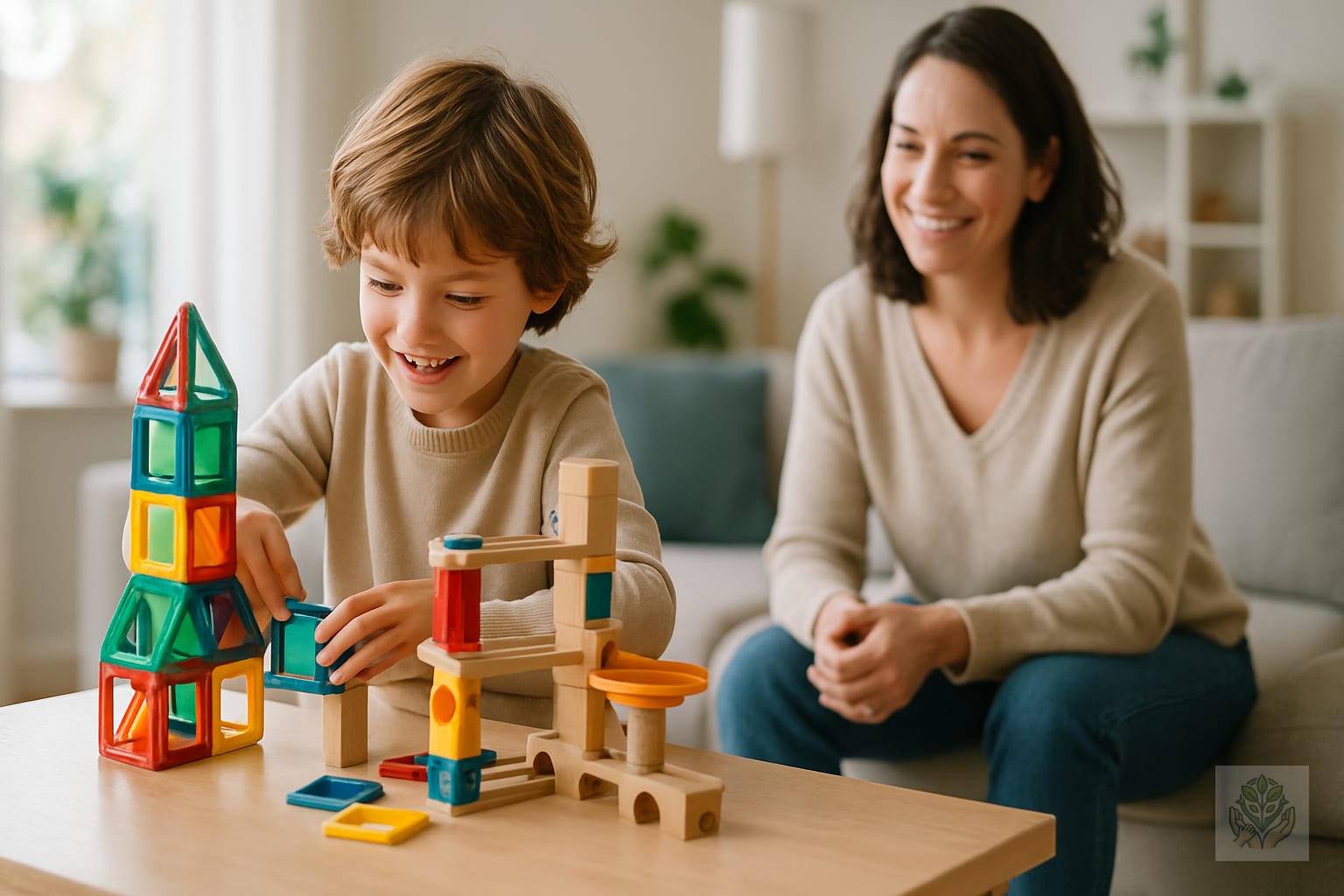
- Magnetic Building Tiles: These are essential for spatial reasoning. They allow children to experiment with geometry and structural integrity in a 3D environment.
- Logic Puzzle Games: Single-player deduction games sharpen critical thinking. They challenge children to use deductive reasoning to solve increasingly difficult puzzles, as outlined in our everything you need to know about educational puzzle games for kids resource.
- Circuitry Kits: These kits provide hands-on experience with cause-and-effect analysis. Understanding how completing a circuit makes a light turn on is a fundamental lesson in technology.
- Mathematical Board Games: Strategy games that require counting, probability, or resource management are fantastic for developing logical decision-making.
- Engineering Sets (Marble Runs): Designing a path for a marble requires an understanding of gravity, friction, and slope, forcing children to plan ahead.
- Programmable Logic Boards: These help children understand how inputs create specific outputs, bridging the gap between hardware and software.
- Fraction and Shape Tangrams: These classic puzzles are surprisingly effective for teaching geometry and spatial relationships.
- Science Experiment Kits: Hands-on biology or chemistry kits encourage children to form a hypothesis and test it, which is the cornerstone of scientific logic.
- Modular Robot Sets: Combining mechanics with movement helps children understand how complex systems work together as a whole.
How to Integrate These Toys into Daily Play
Integrating these toys into your home doesn’t require a rigid schedule. The key is to practice scaffolding. Scaffolding is the act of providing just enough support to help your child move to the next level of understanding without doing the work for them. If your child struggles, resist the urge to jump in with the solution. Instead, ask open-ended questions like, “What do you think would happen if we tried this instead?”
Create a STEM-friendly environment by keeping these items accessible. When building materials and logic games are kept on open shelves, children are more likely to gravitate toward them during independent play. For tips on organizing these spaces, see our guide on 10 clever open storage ideas for a Montessori-inspired kids’ room. Furthermore, encourage collaborative problem solving. Working with a sibling or a parent to solve a logic puzzle teaches children how to communicate their thought processes and consider the perspectives of others.
Frequently Asked Questions (FAQs)
At what age should children start using STEM toys?
Most children can begin with simple tactile STEM toys around age two. As they grow, you can introduce more complex logic games and coding tools that match their developmental stage.
Are expensive STEM toys always better than low-tech alternatives?
Absolutely not. While some high-tech gadgets are wonderful, low-tech alternatives like wooden blocks, pattern blocks, and paper-and-pencil logic puzzles are equally effective at building a strong logical foundation.
How can I tell if a toy is truly improving my child’s logic?
You will notice the difference in their approach to challenges. Instead of giving up when something doesn’t work, a child with improved logical reasoning will stop, evaluate the error, and try a different strategy.
Conclusion
Investing in the best STEM toys that improve logical reasoning skills is an investment in your child’s future. These toys do more than just entertain; they provide a low-stakes environment for children to master the art of thinking. By prioritizing smart play, you are helping your child develop the persistence, curiosity, and analytical mind required to succeed in any field they choose. Start small, stay consistent, and watch as your child discovers the joy of solving problems for themselves.
Frequently Asked Questions
At what age should children start using STEM toys?
Most children can begin playing with simple tactile STEM toys around the age of two. As they grow older, you can introduce more complex logic games and coding tools that match their current developmental stage.
Are expensive STEM toys always better than low-tech alternatives?
No, expensive gadgets are not always better. Low-tech alternatives like wooden blocks, pattern blocks, and puzzles are equally effective at building a strong logical foundation.
How can I tell if a toy is truly improving my child’s logic?
You will notice a change in how they handle challenges. Instead of giving up immediately when something fails, a child with improved logical reasoning will pause, evaluate the mistake, and try a new strategy.
What are the best STEM toys for spatial awareness?
Magnetic building tiles, engineering sets like marble runs, and fraction shape tangrams are excellent choices for developing spatial awareness and geometry skills.
How do coding robots help with logical reasoning?
Coding robots teach sequencing skills by requiring children to plan a path for the robot, helping them break large problems down into smaller, manageable tasks.
How can parents encourage STEM play at home?
You can encourage STEM play by keeping educational toys accessible on open shelves, asking open-ended guidance questions, and participating in collaborative problem-solving activities together.


