

The Complete Guide to Montessori Toys for Every Age: A Developmental Roadmap
As parents, we often find ourselves overwhelmed by the sheer volume of plastic gadgets and battery-operated toys flooding the market. It is easy to assume that more flashing lights and loud sounds equal better engagement for our children. However, the Montessori approach to play suggests something quite different: when it comes to healthy brain development, less is truly more.
By prioritizing Montessori toys for every age, you are not just choosing playthings; you are curating an environment that supports your child’s natural desire to learn, explore, and master their surroundings. In this guide, we will explore why intentional toy selection is a cornerstone of early childhood development and how you can implement these principles at home.
The Core Principles of Montessori Toys
Montessori toys are not merely about aesthetics. They are grounded in scientific observations of how children learn best. Unlike mainstream toys that often do the work for the child, Montessori materials require the child to be an active participant. Understanding these principles helps parents identify high-quality items that will stand the test of time.
Natural Materials
Montessori environments favor natural materials like wood, metal, cotton, and wool. These textures provide authentic sensory feedback that synthetic materials cannot match. When a child holds a smooth wooden block or a weighted metal spoon, they learn about temperature, density, and texture in a way that is grounded in reality.
Reality-Based Play
A key differentiator in the Montessori method is the focus on reality-based activities rather than fantasy. Instead of plastic superhero figures or toy sets that simulate unrealistic worlds, Montessori toys often reflect the child’s actual environment. This helps children make sense of the real world, empowering them to participate in daily tasks like pouring, cleaning, and sorting. You can find more inspiration for these hands-on activities in our educational benefits of pretend play guide.
The Role of Open-Endedness
Open-ended toys are those that do not have a single intended purpose. A set of wooden arches, for instance, can be a tunnel for a car, a bridge for a figurine, or a balancing challenge. These materials grow with your child, inviting complex problem-solving and creative thinking as they age.
Montessori Toys by Developmental Stage
Development happens in rapid bursts during the early years. The best approach is to match your toys to your child’s current sensitive period of learning. For a broader perspective on age-appropriate items, check out our guide on everything you need to know about choosing toys by age.
0-6 Months: Sensory Stimulation and Tracking
During these early months, focus on high-contrast visuals and simple tactile experiences. Mobiles, soft grasping balls, and wooden rattles help develop visual tracking and hand-eye coordination. Keep the environment quiet and uncluttered to prevent sensory overload.
6-12 Months: Object Permanence and Grasping
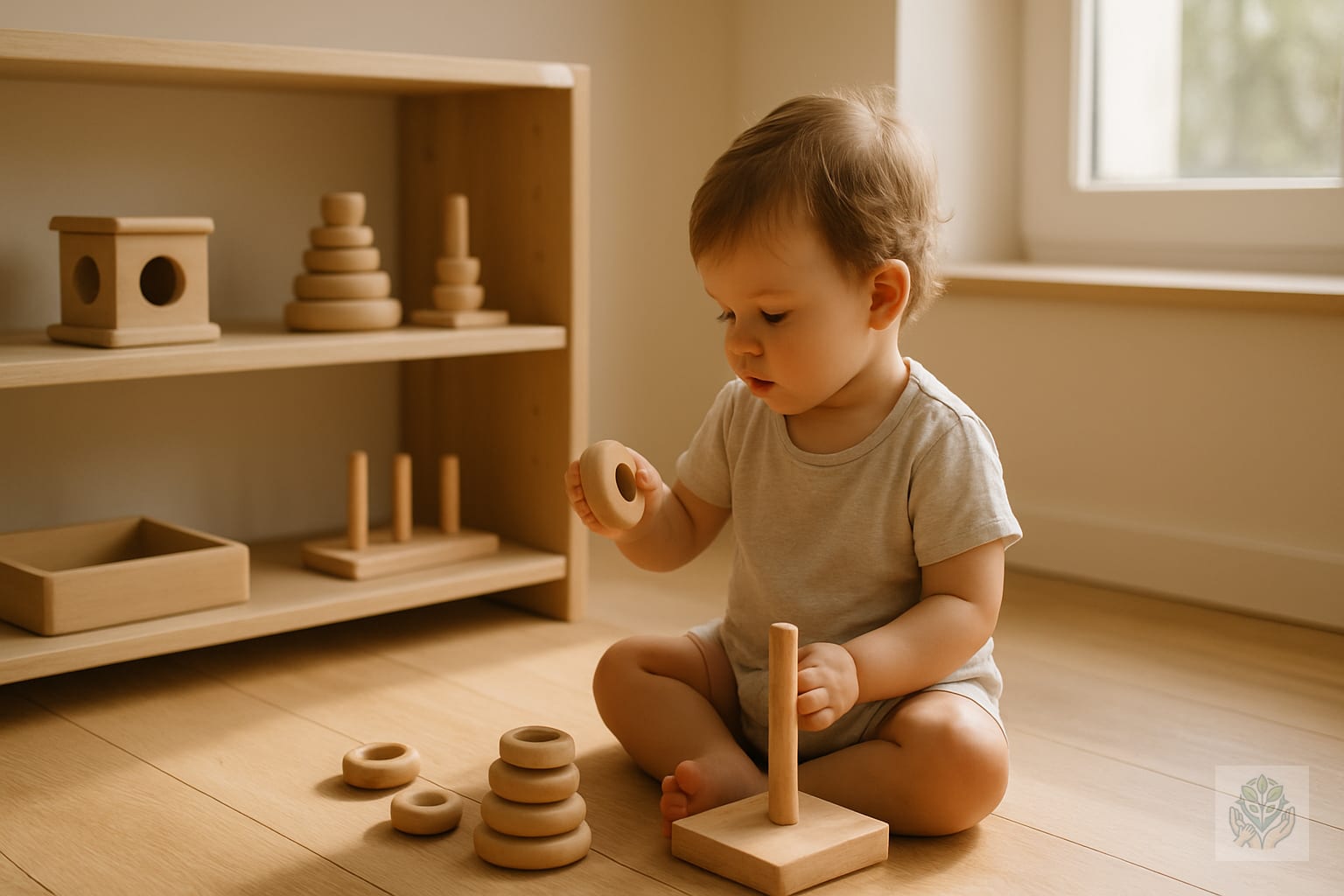
As your baby begins to sit and crawl, they are fascinated by the concept of object permanence. Toys like object permanence boxes, simple shape sorters, and stacking rings allow them to practice the pincer grasp and explore cause-and-effect relationships.
12-24 Months: Fine Motor Skills and Practical Life
This is the age of exploration. Children are eager to mimic adults. Introduce tools that allow them to practice practical life skills, such as small pitchers for pouring water, child-sized brooms, or simple puzzles. These activities refine their fine motor skills and build confidence. Many of these skills are also boosted by 15 engaging indoor activities that improve fine motor skills for kids.
2-3 Years: Language, Classification, and Coordination
At this stage, children enjoy categorizing the world around them. Provide sorting trays, animal figurines that match realistic flashcards, and simple lacing beads. These activities support early mathematical thinking and language development through classification.
3-5 Years: Creative Problem Solving and Complex Practical Life
Preschoolers are capable of longer bouts of focus. Introduce more complex puzzles, materials for writing preparation, and elaborate practical life tasks like food preparation or buttoning frames. The goal here is mastery and the refinement of complex movements.
Practical Tips for Your Montessori Playroom
Setting up your home environment is just as important as the toys themselves. Here is how to create a space that encourages independent exploration. You might also consider setting up a simple preschool learning corner to further support their development.
- Rotate your toys: Keep only 6-8 toys available at a time. Rotate them out every two weeks to keep your child interested and prevent clutter.
- Create a ‘yes’ space: Use low, open shelves so that children can access their materials independently without needing to ask for help.
- Observe your child: Pay attention to what your child is drawn to. If they are constantly dumping boxes, they may need a sorting activity. Follow their lead.
Common Montessori Myths Debunked
There is a common misconception that Montessori toys for every age must be expensive, boutique items. This is simply not true. Montessori is a philosophy of mind, not a price tag. You do not need to purchase expensive wooden sets to reap the benefits. Furthermore, while plastic is often discouraged due to texture and durability, a single high-quality, long-lasting plastic item is arguably more aligned with Montessori than a house full of flimsy, single-use toys.
How to Select Quality Montessori Toys on a Budget
You can build a beautiful Montessori-inspired environment without breaking the bank. Many of the best “toys” are actually everyday household items. Stainless steel bowls, whisking tools, and cotton rags are often more engaging for children than dedicated playthings. When purchasing toys, look for heirloom-quality wood or metal items that can be passed down to siblings or friends. Thrifting is another excellent way to find pre-loved wooden puzzles and baskets at a fraction of the cost.
Conclusion
Incorporating Montessori toys for every age into your home is an investment in your child’s independence, confidence, and ability to focus. By choosing materials that reflect reality, offer natural sensory feedback, and grow with your child’s capabilities, you provide a foundation for a lifetime of curiosity. Remember, the best toy is always the one that engages your child’s interest while encouraging them to interact with the world around them. Start small, observe your child, and enjoy the process of watching them learn. For more expert tips, check out our article on everything you need to know about Montessori learning toys.
Ready to simplify your home? Sign up for our newsletter to receive our exclusive Montessori Toy Rotation Checklist to help you organize your play space with ease.
Frequently Asked Questions
What are Montessori toys?
Montessori toys are simple, purposeful playthings made from natural materials that encourage active, hands-on learning and independence rather than passive entertainment.
Are plastic toys allowed in the Montessori method?
While natural materials like wood and metal are preferred for their sensory feedback, durability and long-term use matter more than rigid rules against plastic.
How do I choose Montessori toys for newborns?
For newborns aged 0-6 months, focus on high-contrast visual mobiles, soft grasping balls, and simple wooden rattles to support tracking and sensory awareness.
Do Montessori toys have to be expensive?
No, Montessori is a philosophy rather than a price tag. Everyday household items like stainless steel bowls and whisking tools can serve as wonderful developmental toys.
How often should I rotate my child’s toys?
It is recommended to keep only 6 to 8 toys accessible at a time and rotate them out every two weeks to maintain interest and prevent clutter.
Why do Montessori toys avoid fantasy?
Montessori emphasizes reality-based play to help young children make sense of their actual environment and master practical life skills.


