

Toys That Match Every Developmental Milestone: A Parent’s Guide
Introduction
Walking down the toy aisle can feel completely overwhelming. With thousands of flashing lights, musical gadgets, and clever marketing claims, finding the right items for your child is tough. As parents, we want to give our little ones the absolute best start in life. But did you know that the secret to early learning isn’t a high-tech tablet? It is actually intentional play.
When you choose toys that match every developmental milestone, you do much more than just keep your child busy. You actively build their brain, strengthen their muscles, and support critical cognitive growth. Let us explore how purposeful play shapes your child’s earliest years.
Why Intentional Play Matters for Early Childhood Development
Play is a child’s natural language and primary job. Through play, babies and toddlers make sense of the physical world around them. Intentional play means offering items that challenge your child just enough to learn a new skill without causing frustration. This approach builds resilience, sparks curiosity, and lays a solid foundation for lifelong learning. Discover more insights on selecting appropriate items through our complete guide to choosing age-wise toys for kids.
How Toys Act as Tools for Milestone Achievement
Think of well-chosen playthings as developmental tools rather than mere sources of entertainment. A simple rattle helps a baby understand cause and effect. A stacking cup teaches spatial awareness and early math concepts. By matching specific items to current developmental stages, you accelerate natural learning processes naturally and joyfully.
Phase 1: Newborn to 3 Months – Sensory Awakening & Early Motor Skills
The first few months of life are all about gentle adjustment and sensory awakening. Your newborn is rapidly adapting to a bright, loud world outside the womb. During this stage, your baby takes in immense amounts of sensory information.
Key Developmental Milestones
In these early weeks, babies learn to focus their eyes on high-contrast patterns and track moving objects. They also begin lifting their heads slightly during tummy time and turning toward familiar voices. Supporting these physical gains sets the stage for future mobility.
Best Toys for This Stage
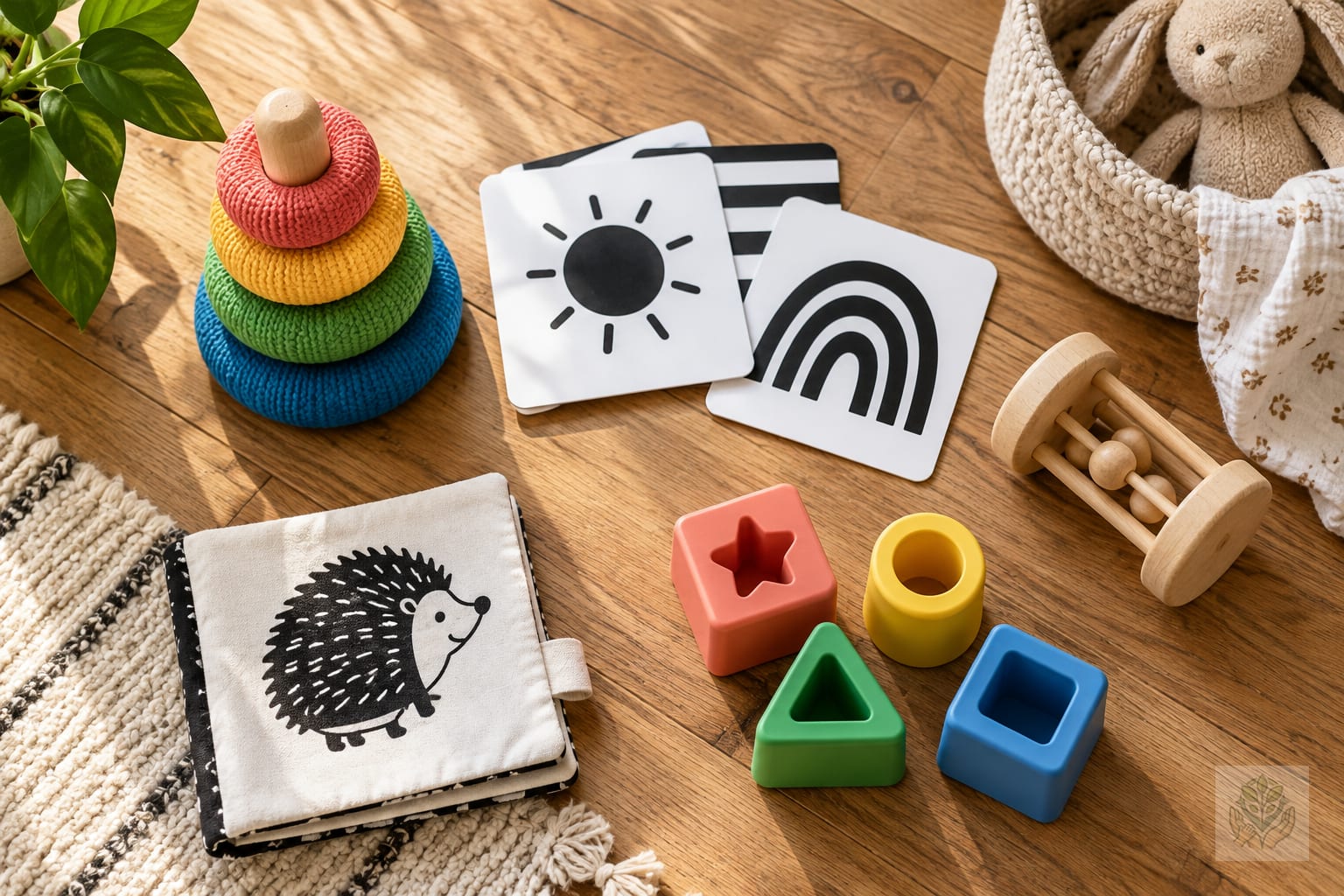
Newborns do not need complex gadgets. Instead, look for black-and-white flashcards, gentle mobiles that hang securely above a crib, and lightweight soft rattles that are easy to bat at. These items stimulate developing eyesight and encourage basic auditory tracking without overwhelming immature nervous systems.
Expert Tip: Avoiding Overstimulation
Newborn senses fatigue quickly. If your baby turns their head away, arches their back, or starts crying inconsolably, it is time to put the play items away and offer a quiet cuddle. Less is truly more during the fourth trimester.
Phase 2: 4 to 6 Months – Grasping, Reaching, and Cause & Effect
Around four months, babies discover their hands and realize they can make things happen in their environment. This realization marks an exciting explosion in hand-eye coordination and physical strength.
Key Developmental Milestones
Your baby will likely master rolling over in both directions and passing objects smoothly from one hand to the other. Many babies also start sitting up with minor support, freeing up their hands for active exploration.
Best Toys for This Stage
Textured teething rings, soft fabric blocks, and stroller activity bars work wonders here. These items encourage reaching, grasping, and mouthing—which is how babies safely explore object textures and shapes.
Expert Tip: Encouraging Tummy Time Through Play
Tummy time builds essential upper body strength, but many babies protest. Place a colorful rattle, a baby-safe mirror, or crinkly board books just out of reach during tummy time to motivate them to lift their heads and reach forward.
Phase 3: 7 to 9 Months – Mobility and Fine Motor Precision
Mobility changes everything! Whether your baby is army crawling, scooting, or rocking on hands and knees, their world is expanding rapidly. Fine motor skills also take a massive leap forward.
Key Developmental Milestones
At this age, babies develop the pincer grasp, using their thumb and forefinger to pick up small objects. They also begin to understand object permanence—realizing that things still exist even when hidden out of sight.
Best Toys for This Stage
Classic stacking rings, balls that roll away to encourage crawling, and lift-the-flap board books are absolute essentials. These items challenge your baby’s growing dexterity and problem-solving skills.
Expert Tip: Creating Safe Spaces to Explore
As your baby becomes mobile, baby-proof your living areas thoroughly. Provide a safe, gated floor space filled with appropriate toys so your little explorer can practice crawling and cruising without constant redirection. You can find helpful childproofing tips in our ultimate child proofing guide.
Phase 4: 10 to 12 Months – First Steps and Problem Solving
As your baby approaches their first birthday, they transition from infancy into active toddlerhood. Independence is on the horizon, and curiosity is at an all-time high.
Key Developmental Milestones
Many babies pull themselves up on furniture, cruise along sofas, and take their very first independent steps. Their receptive and expressive language skills also bloom as they babble and imitate sounds.
Best Toys for This Stage
Sturdy push walkers help stabilize early steps. Simple shape sorters teach spatial relationships, while toy drums and xylophones satisfy their desire to create loud, satisfying noises.
Expert Tip: Supporting Independence During Play
Allow your toddler to figure out simple puzzles or container play on their own. Resist the urge to jump in and solve the problem immediately. Giving them time to puzzle things out builds confidence and critical thinking.
Phase 5: Toddlerhood (12 to 24 Months) – Active Movement & Imagination
The toddler years bring boundless energy, rapid vocabulary growth, and the wonderful beginnings of pretend play. Your child is no longer just observing the world—they want to participate in it.
Key Developmental Milestones
Toddlers walk and run with increasing confidence, begin combining words into short phrases, and start imitating everyday adult actions like talking on a phone or feeding a stuffed animal.
Best Toys for This Stage
Pounding benches release physical energy safely. Chunky wooden puzzles refine fine motor precision, and safe foot-to-floor ride-on toys build leg strength and gross motor balance. To explore similar play ideas, check out our resource on Montessori toys for every age.
Expert Tip: Embracing Messy and Sensory Play
Sensory experiences are crucial for toddler brain development. Set aside time for finger painting, playing with kinetic sand, or splashing in a water table. Messy play supports sensory processing and creativity.
Phase 6: Preschool (2 to 5 Years) – Social Skills, Complex Logic & Creativity
Preschoolers possess rich imaginations and incredible social capacity. Their play becomes more cooperative, structured, and narrative-driven as they learn to navigate friendships and complex rules.
Key Developmental Milestones
Children in this age bracket learn to share, take turns, use safety scissors, hold pencils correctly, and manage big emotional outbursts with growing independence.
Best Toys for This Stage
Open-ended wooden blocks, cooperative junior board games, and dress-up costumes foster teamwork, narrative thinking, and complex problem-solving abilities. Incorporating items that encourage imagination is further detailed in our complete guide to pretend play for child development.
Expert Tip: The Power of Open-Ended Toys
Toys with single, fixed functions often bore children quickly. Prioritize open-ended materials like blocks, play silks, and magnetic tiles that grow with your child and adapt to endless new storylines.
How to Declutter and Rotate Toys for Maximum Developmental Benefit
Having too many options available at once can overwhelm young children, leading to scattered attention spans and messy playrooms. Implementing a thoughtful organization strategy transforms how your child interacts with their belongings.
The Benefits of Toy Rotation
By dividing your child’s collection into bins and swapping them out every few weeks, old items feel brand new again. Toy rotation reduces clutter, encourages deeper focus, and sparks renewed creativity without spending extra money.
Quality Over Quantity: Choosing Sustainable, Durable Materials
When selecting new items, look for sustainably sourced wood, non-toxic finishes, and durable plastics built to withstand years of enthusiastic play. High-quality pieces can be passed down to siblings or future generations. You can also explore options like those discussed in our analysis of wooden Montessori toys vs plastic toys.
Conclusion
Selecting toys that match every developmental milestone transforms ordinary playtime into a powerful engine for early learning and growth. By tuning into your child’s current abilities and offering purposeful, age-appropriate items, you provide the ideal environment for them to thrive.
What is your child’s favorite developmental toy right now? Share your thoughts in the comments below, or subscribe to our newsletter for more expert-backed parenting tips delivered straight to your inbox!
Frequently Asked Questions
Why are toys that match every developmental milestone important?
They actively build a child’s brain, strengthen muscles, and support critical cognitive growth by challenging them just enough to learn new skills without frustration.
What are the best toys for newborns up to 3 months?
Newborns benefit most from high-contrast flashcards, hanging crib mobiles, and lightweight soft rattles that stimulate developing eyesight and basic auditory tracking.
How do toys help babies during the 4 to 6-month stage?
Items like teething rings, soft fabric blocks, and activity bars encourage reaching, grasping, hand-eye coordination, and safe sensory exploration through mouthing.
What developmental milestones occur between 7 and 9 months?
Babies develop a pincer grasp, learn to crawl or scoot, understand object permanence, and improve their fine motor dexterity.
What are open-ended toys and why are they beneficial for preschoolers?
Open-ended toys like building blocks and magnetic tiles have no single fixed function, allowing children to adapt them to endless storylines and foster creativity.
How does toy rotation benefit young children?
Toy rotation reduces clutter and overwhelm by swapping out items every few weeks, making old toys feel brand new and encouraging deeper focus and creativity.