

10 Creative DIY Crafts That Encourage Problem-Solving Skills in Kids
As parents, we often look for activities that do more than just pass the time. We want experiences that nourish our children’s growing brains. One of the most effective ways to foster cognitive development is through creative DIY crafts that encourage problem-solving skills in kids. When children engage in open-ended crafting, they are not just making art; they are learning to navigate challenges, experiment with physics, and iterate on their own ideas. You can explore more ideas for inspiration with our 15 indoor activities that encourage creative thinking in kids.
Crafting serves as a bridge between abstract thinking and physical manifestation. By taking raw materials and transforming them into functional items, children learn that they have the power to influence their world. This process strengthens their executive function, helping them plan, focus, and adjust their strategy when things do not go as expected.
Why Problem-Solving Skills Matter for Early Development
At its core, problem-solving is the ability to identify a challenge, generate potential solutions, and test them until one succeeds. When children practice this through play, they are developing cognitive flexibility. This skill allows them to switch between tasks and adapt their thinking to meet new demands.
The creative process is inherently built on trial and error. Whether it is a glue joint that will not hold or a structure that keeps tipping over, these small hurdles are actually golden opportunities. By encouraging our children to solve these minor crises, we teach them resilience. They learn that a mistake is not a failure, but rather a vital piece of data that points them toward a better solution.
Creative DIY Crafts for Kids
Craft 1: DIY Marble Run (Engineering & Physics)
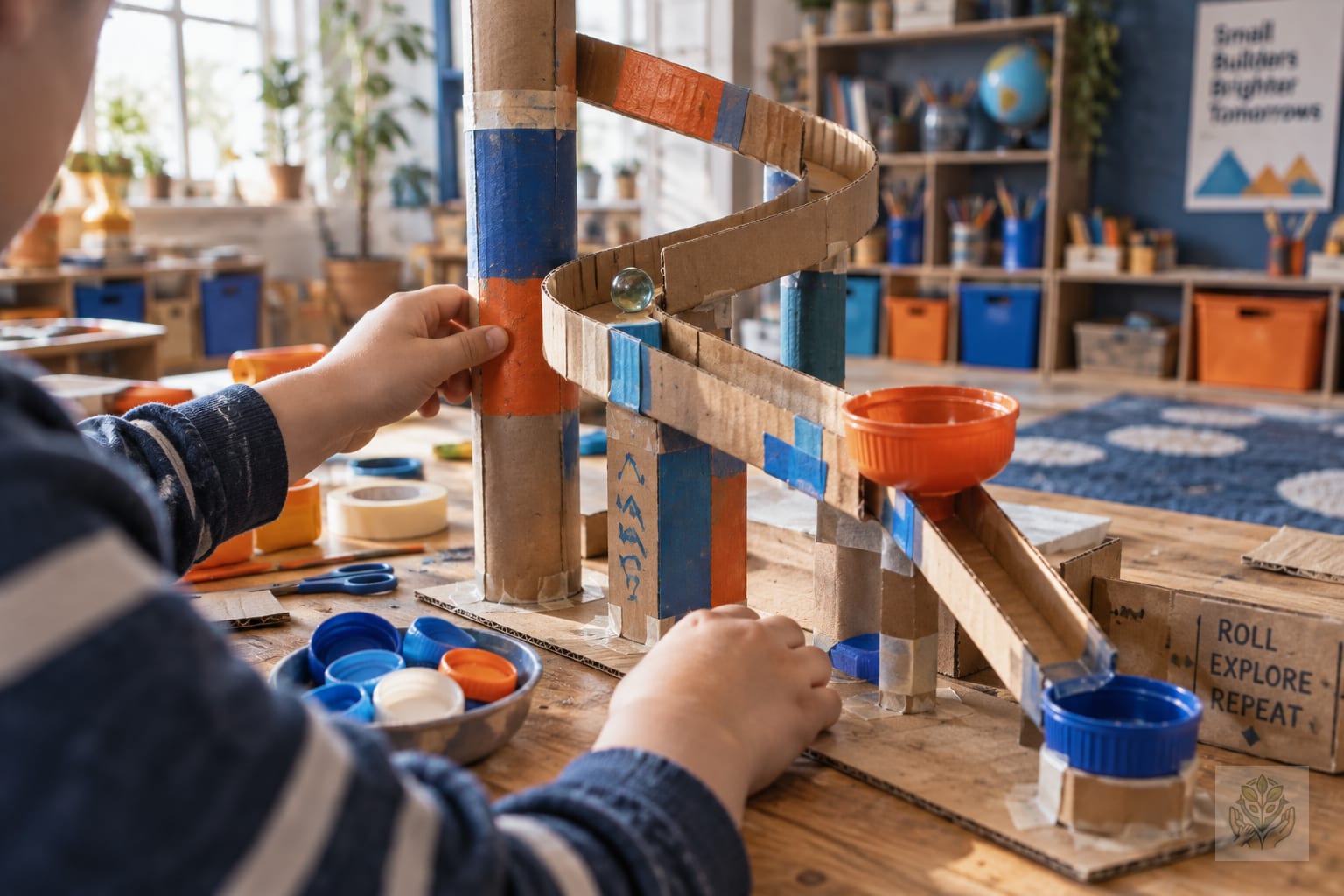
Building a marble run is a classic way to introduce creative DIY crafts that encourage problem-solving skills in kids. For this project, you will need cardboard tubes, masking tape, shallow boxes, and a marble.
The main challenge is straightforward: how can you design a track that allows the marble to travel from the top to the bottom without getting stuck? This task forces children to think about gravity, momentum, and the importance of steepness. If the marble stops, they must analyze why and adjust the track accordingly. It is a fantastic exercise in architectural planning and basic physics. For other science-oriented play concepts, check out this guide on complete guide to STEM toys for kids of every age.
Craft 2: Cardboard Box Forts & Engineering (Structural Design)
Every child loves a fort, but turning it into an engineering project makes it an incredible learning experience. Gather various sizes of cardboard boxes, heavy-duty tape, and perhaps some clips or fasteners.
The problem here is maximizing space and ensuring structural integrity so the fort does not collapse. Children must consider load-bearing concepts, such as how to stack boxes so the roof stays up. This develops spatial reasoning and teaches them how to distribute weight effectively. It is a masterclass in stability and logic disguised as play.
Craft 3: Recycled Material Robots (Resourcefulness & Assembly)
Give your child a bin of recyclables—yogurt cups, bottle caps, wire, and boxes—and challenge them to create a robot. The core issue is connectivity: how do you join these mismatched shapes into a single, cohesive unit?
This requires significant pattern recognition and creative design. If the arm is too heavy for the body, the robot will tip over. How can they counterbalance it? This project encourages resourcefulness as they learn that the first solution is not always the best one, and that engineering involves a fair amount of revision.
Craft 4: DIY Puzzles and Tangrams (Logical Sequencing)
Create your own custom puzzles by drawing a picture on a square of cardboard and cutting it into irregular shapes. For a more structured challenge, look into the concept of tangrams, which uses geometric shapes to recreate silhouettes. You can also read more about spatial challenges in our complete guide to puzzle games for kids of every age.
The objective is to fit these parts back together to recreate the original image. This task builds strong visual-spatial skills. It forces children to rotate shapes mentally and predict how edges will align, which is a foundational skill for later mathematical success. Discover related options in our breakdown of 10 best STEM toys that improve logical reasoning skills in children.
How to Guide Without Taking Over (Parenting Tips)
It is easy to fall into the trap of doing the work for your child, especially when you see them getting frustrated. However, the true value of creative DIY crafts that encourage problem-solving skills in kids lies in the child doing the heavy lifting.
Use the technique of scaffolding. Instead of fixing a problem yourself, ask open-ended questions like, What do you think would happen if we moved this piece to the left? or Can you see why the tape is peeling off? By acting as a consultant rather than a foreman, you foster a safe environment where curiosity thrives. Let them experience the satisfaction of overcoming an obstacle on their own. For further support on encouraging independent activities, see our post on 10 Montessori toys that encourage independent play.
Conclusion
Integrating these activities into your weekly routine provides children with the tools they need to navigate a complex world. Remember, it is always about the process, not the product. The most beautiful sculpture is the one your child built while working through the frustration of a falling support beam.
By choosing creative DIY crafts that encourage problem-solving skills in kids, you are laying the groundwork for a future of confident, innovative thinking. Do you have a favorite project that kept your child engaged for hours? We would love to hear your experiences in the comments below!
Frequently Asked Questions
What are DIY crafts that encourage problem-solving skills?
These are open-ended crafting activities where children must figure out how to build, connect, or balance materials, which helps them develop critical thinking, spatial reasoning, and resilience.
How do crafts improve cognitive development in children?
Crafting bridges abstract thinking and physical creation. It strengthens executive functions by teaching kids how to plan, focus, and adjust their strategies when challenges arise during play.
What materials are needed for a DIY marble run?
You will need basic household items such as cardboard tubes, masking tape, shallow boxes, and a marble to test gravity and momentum.
How can I help my child without taking over the project?
Use scaffolding by asking open-ended questions like ‘What happens if we move this piece?’ instead of fixing the problem yourself, allowing your child to experience the satisfaction of overcoming obstacles.
Why is trial and error important in children’s crafts?
Trial and error teaches children that mistakes are not failures but valuable data that guides them toward finding a better solution, building confidence and resilience.
At what age can kids start doing problem-solving crafts?
Toddlers and preschoolers can start with simple stacking or sorting crafts, while older children can tackle complex engineering projects like cardboard robots and structured marble runs.


