

Everything You Need to Know About Montessori Learning Toys: A Parent’s Guide
Walking into a modern toy store can feel overwhelming. Bright flashing lights, loud electronic sounds, and endless plastic gadgets often dominate the aisles. Yet, many parents today are choosing a different path. They are trading flashy commercial toys for something much simpler, more intentional, and deeply rooted in child development: Montessori learning toys.
If you have wondered what makes these educational toys so special or how to incorporate them into your home, you are in the right place. This guide walks you through everything you need to know about Montessori play, helping you nurture your child’s natural love for learning.
What is the Montessori Method?
Developed by Dr. Maria Montessori in the early 20th century, the Montessori educational philosophy views children as naturally eager knowledge-seekers capable of initiating learning in a supportive, thoughtfully prepared environment. Instead of forcing children to memorize facts, the Montessori approach provides hands-on materials that allow kids to discover concepts independently through trial, error, and exploration.
At the heart of this philosophy is respect for the child’s individual developmental timeline. Children are given the freedom to choose their activities, work at their own pace, and immerse themselves in deep, uninterrupted concentration. The adult acts not as a strict instructor, but as a gentle guide who prepares the environment and steps back to let the child explore, a principle shared by many positive parenting habits.
Why Montessori Toys Are Gaining Popularity Among Modern Parents
In a world saturated with digital screens and overstimulating entertainment, modern parents are increasingly searching for ways to slow down. Montessori learning toys offer a refreshing antidote to consumerism and screen time. They encourage active engagement rather than passive observation.
Parents love these toys because they promote calm, purposeful play. Instead of a toy doing all the work—like singing a song or lighting up automatically—a Montessori toy requires the child to think, manipulate, and problem-solve. This style of play respects the child’s capability and builds lasting confidence.
What Makes a Toy ‘Montessori’?
Not every wooden toy on the market qualifies as a Montessori material. True Montessori toys share specific characteristics designed to align with how children naturally learn and process the world around them.
Key Principles of Montessori Play
Montessori toys are rooted in reality rather than fantasy. While talking animals and magical creatures have their place in storytelling, young children are primarily trying to make sense of the real physical world. Therefore, Montessori toys reflect real-world mechanics, nature, and practical life skills.
Another crucial principle is isolation of difficulty. A good Montessori toy focuses on teaching one specific skill at a time. For example, a shape-sorter might focus strictly on circles and squares rather than mixing shapes, colors, and textures all at once. This prevents cognitive overload and allows the child to master a single concept successfully.
Natural Materials vs. Plastic
You will notice that most Montessori learning toys are crafted from natural materials such as wood, metal, cotton, wool, and glass. Natural materials offer rich sensory experiences, similar to the benefits of texture coloring activities for toddlers. They have weight, unique textures, natural warmth, and subtle scents that synthetic plastics simply cannot replicate.
Furthermore, wooden and metal toys are durable enough to be passed down through generations. They age gracefully, developing character over time, which subtly teaches children to value and care for their belongings.
The Concept of ‘Control of Error’
One of the most brilliant aspects of Montessori design is the built-in control of error. This means the toy itself shows the child whether they are using it correctly, without needing an adult to correct them. If a puzzle piece does not fit into a slot, the child instantly sees and feels that it is wrong, prompting them to try another approach.
This self-correcting feature removes the fear of failure. Children learn to view mistakes as natural steps in the learning process rather than reasons to feel discouraged.
The Core Benefits of Montessori Learning Toys
Integrating Montessori learning toys into your child’s daily routine yields remarkable benefits that extend far beyond early childhood.
Fostering Independent Problem Solving
Because Montessori toys feature built-in controls of error, children learn to troubleshoot independently. When a toddler figures out how to stack rings in the correct size order without adult intervention, they experience a powerful surge of self-reliance. This independence lays a strong foundation for critical thinking later in life.
Encouraging Deep Concentration and Focus
Busy, flashing toys often create short attention spans by constantly demanding a child’s attention. In contrast, simple wooden toys invite deep, sustained focus. When a child engages in purposeful work, they enter a state of deep concentration, which scientists refer to as flow.
Developing Fine Motor Skills and Hand-Eye Coordination
Many Montessori toys require precise physical manipulation. Threading beads, using tongs, fitting pegs into holes, and turning wooden screws all require refined hand-eye coordination and strengthen the small muscles in a child’s hands, fingers, and wrists.
Promoting Open-Ended Creativity
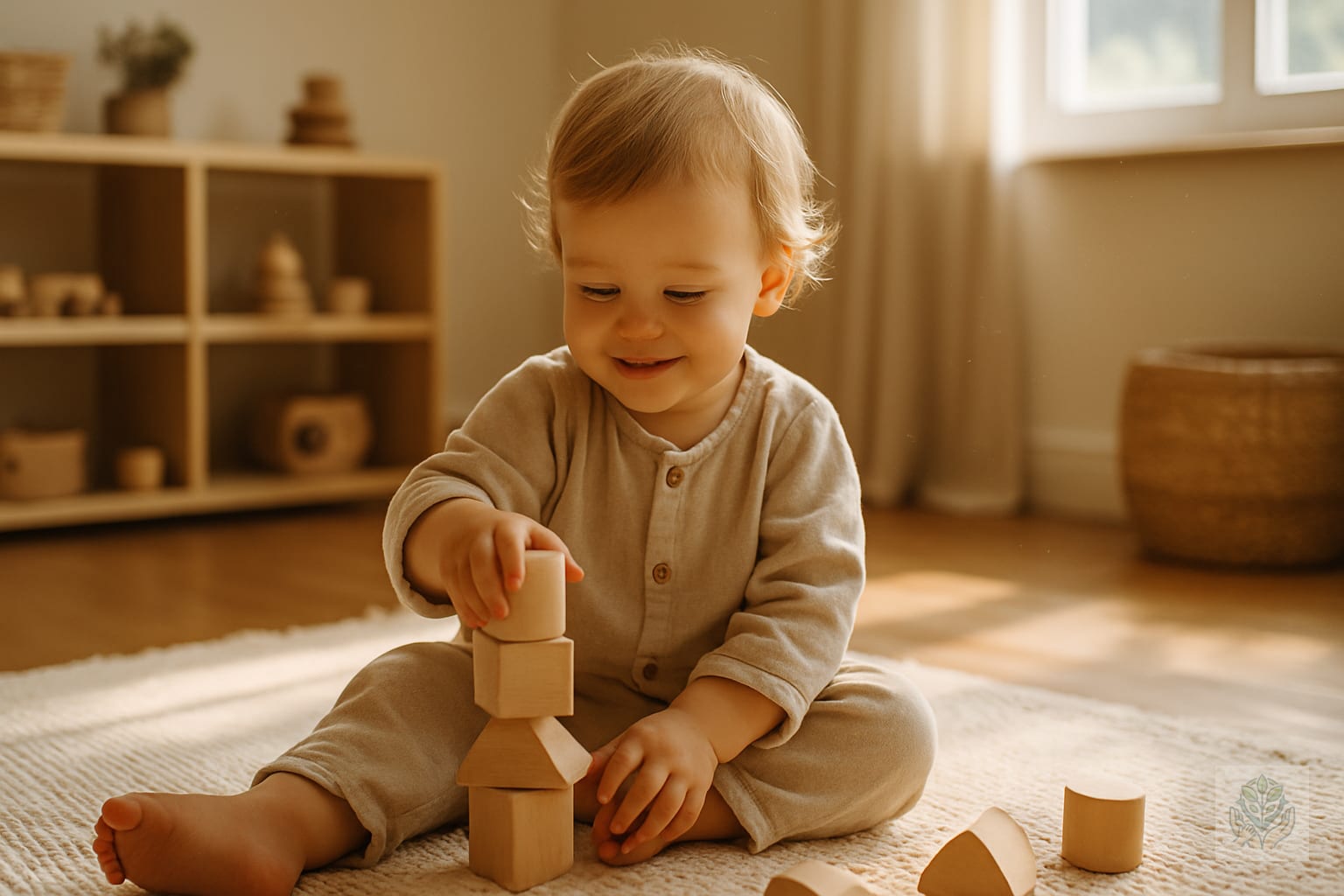
Montessori toys are intentionally open-ended. A set of simple wooden blocks can become a bridge, a castle, a train track, or a mountain depending on the day’s imagination. This versatility keeps play fresh and encourages boundless creative thinking.
Montessori Toys by Developmental Stage
Children’s developmental needs change rapidly during their first six years. Here is a guide to selecting appropriate toys for each stage.
Infants (0-12 Months): Mobiles, Rattle Toys, and Grasping Objects
For newborns and young infants, visual and tactile stimulation is key. High-contrast visual mobiles hang above the changing table to help develop visual tracking. As babies grow, lightweight wooden rattles and grasping cylinders help them practice intentional reaching, grasping, and transferring objects from hand to hand.
Toddlers (1-3 Years): Object Permanence Boxes, Puzzles, and Pouring Sets
Toddlers are fascinated by how things work and how their bodies interact with the environment. Object permanence boxes help them understand that hidden items still exist. Simple knobbed puzzles, stacking cylinders, and child-sized pouring sets involving water or dry grains satisfy their endless desire to practice practical life tasks.
Preschoolers (3-6 Years): Counting Beads, Practical Life Materials, and Letter Boards
Preschool-aged children are ready for more abstract concepts. Mathematical bead bars, sandpaper letters for tactile alphabet learning, and real-life sewing or gardening kits allow them to refine academic skills while building profound life competence. You can also explore our preschool activities for early learning guide.
How to Choose the Right Montessori Toys for Your Child
Curating a thoughtful play space does not require buying every expensive educational toy on the market. Follow these simple guidelines to make wise choices.
Following the Child’s Interests
Observe your child closely. Are they fascinated by animals, obsessed with dropping things, or currently trying to master buttons and zippers? Choose toys that align with their current developmental sensitivities rather than buying items based purely on age recommendations.
Quality Over Quantity: Curating a Minimalist Play Space
A cluttered toy room often leads to overwhelmed children who flit quickly from one toy to the next without truly engaging. Practice toy rotation by keeping only six to eight toys accessible at any given time, which is helpful when organizing indoor toddler activities. Store the rest away and swap them out every few weeks to make old toys feel brand new.
Red Flags: What to Avoid When Buying Montessori-Style Toys
Be cautious of marketing gimmicks. If a toy requires batteries, makes electronic sounds, or does all the playing for the child, it is not aligned with Montessori principles. Also avoid toys with overly fragile parts or toxic finishes.
Top DIY and Budget-Friendly Montessori Toy Ideas
You do not need a massive budget to embrace Montessori principles at home. Many everyday household items serve as exceptional sensory and learning tools, much like the projects found in our guide to DIY crafts for kids.
Using Household Items for Sensory Play
A muffin tin paired with a metal spoon and a few dried beans provides hours of fine motor sorting practice. Plastic bowls, measuring cups, and sponges used during bath time teach volume, weight, and cause-and-effect. Colanders with pipe cleaners inserted through the holes make fantastic DIY fine-motor toys.
Rotating Toys to Keep Play Fresh and Engaging
Toy rotation is completely free and yields incredible results. By placing a portion of your child’s toys out of sight in a closet and bringing them back out a month later, you spark renewed curiosity without spending a single penny.
Conclusion
Embracing Montessori learning toys is about much more than just decluttering your living room or buying wooden playthings. It is an intentional shift toward respecting your child as an independent, capable learner who thrives in a calm, purposeful environment.
Remember that your presence, patience, and willingness to step back and let your child explore are far more valuable than any toy you can purchase. Enjoy this wonderful journey of watching your child discover the world on their own terms.
Frequently Asked Questions
What are Montessori learning toys?
Montessori learning toys are intentional, hands-on educational playthings typically made from natural materials. They are designed to teach a single concept at a time, encouraging independent problem-solving and deep concentration.
Are Montessori toys always made of wood?
While many Montessori toys are crafted from wood, metal, cotton, or glass to provide rich sensory experiences, the material alone does not define them. The core principle is purposeful, reality-based play without electronic distractions.
How do Montessori toys help with child development?
They foster fine motor skills, hand-eye coordination, and critical thinking. Because they feature built-in controls of error, children learn to correct their own mistakes, building resilience and lasting self-confidence.
At what age can children start using Montessori toys?
Children can use Montessori-inspired items from birth. Infants benefit from high-contrast visual mobiles and simple grasping rattles, while older toddlers and preschoolers use object permanence boxes, puzzles, and practical life materials.
How do I choose the right Montessori toys for my child?
Observe your child’s current interests and developmental stage rather than relying strictly on age labels. Choose open-ended toys that promote active engagement rather than passive observation.
Can I use household items as Montessori toys?
Yes! Everyday objects like metal spoons, muffin tins, measuring cups, and colanders make fantastic, budget-friendly tools for sensory exploration and fine motor skill practice.


